
Temple Terrace Previous Resident Sources
A backward address trail changes source as it crosses each records era. Start with the newest reliable parcel identity. The current roll and deeds establish title, while directories and census schedules address occupancy. Newspapers, probate, and obituaries may explain why a name appeared or disappeared. Temple Terrace incorporated in 1925, so earlier land records will sit under county recordkeeping or development entities rather than a city office.
| Source | Verified years | Where held | What it contributes |
|---|---|---|---|
| Official Records online | 1965 to present | Hillsborough Clerk portal | Transfer parties and land descriptions |
| Official Records Library | 1836 to present | Clerk in Tampa | Earlier books, indexes, and microfilm |
| County tax rolls | 1883 to present | Clerk and Tax Collector | Assessed taxpayer and parcel context |
| Federal census | Released through 1950 | NARA and library databases | Enumerated households |
| Temple Terrace permits | 1998 to present | City request form | Work, issue date, and permit status |
| Obituary index | 1855 to 1990 | HCPLC | Death and family trail leads |
| Directories | Exact local runs unverified | Library reference request | Name-to-address and reverse entries |
Choose by time and question. A deed answers ownership, not who slept in the home. A census names the enumerated household, but only for a released census date. A permit dates work, not a move. Labeling those roles prevents a neat timeline from becoming a false one.
Anchor a Temple Terrace Address
Search the Hillsborough Property Appraiser by address. Copy the current owner, folio or parcel number, mailing address, physical address, legal description, homestead indicator, and any deed reference. The folio is a stable assessment identifier. The legal description links the land through a lot, block, subdivision, plat, or measured boundary even when street text changes.
Mailing and situs addresses are separate fields. A different mailing address can suggest that tax mail goes elsewhere, but it cannot prove absence from the parcel. Homestead can support owner occupancy, yet its timing, trusts, life estates, and stale records rule out certainty. Finding previous residents requires more than reversing a current owner list.
The modern property search is fully explored on the Temple Terrace street directory page. For the backward trail, save enough parcel detail to reject same-name deeds and to follow the same land across decades.
Walk Hillsborough Deeds Backward
The deed chain starts with today's owner as grantee, the party that received title. Search that name in the Clerk Official Records index and isolate the purchase instrument by recording date and legal description. Read the image. The seller is the grantor. Search that seller as a grantee at an earlier date and repeat.
- Copy the current folio and full legal description from HCPA.
- Find the current owner's acquisition deed in Official Records.
- Confirm the parcel in the instrument image, not just the result row.
- Record the grantor, date, instrument number, and stated legal description.
- Search that grantor as an earlier grantee and continue to the 1965 online cutoff.
- Move to the Official Records Library for older grantor and grantee books.
A common surname can produce many unrelated instruments. The public search must be narrowed when results exceed 5,000. Result fields may include two parties, recording date, document type, instrument number, and legal description when indexed. Free watermarked images are available for unrestricted documents, while restricted images may require qualified or in-person access.
- Grantor
- The party transferring an interest, often the seller in a deed.
- Grantee
- The party receiving an interest, often the buyer.
- Chain of title
- The sequence of recorded transfers for the same parcel.
- Legal description
- The deed's formal identity for the land, stronger than a mailing label.
Temple Terrace Deeds Before 1965
The public online Official Records index reaches back to 1965. That is a digital cutoff, not the beginning of county land records. The Clerk's Official Records Library holds material from 1836, and the archive interface includes deed indexes for 1948 through 1957 and Official Record indexes for 1958 through 1966. Earlier research therefore moves from a browser to archive indexes, books, microfilm, staff help, or a focused records request.
The Clerk's Official Records page explains the historical access path. Search and copy charges are distinct from free online browsing. Research lists $2 per year for staff search, $1 per page, and $2 for certification. State law also permits inspection and a request that specifies the subject, date range, name variants, and desired format.
The older library route matters because Temple Terrace was incorporated only in 1925. Early deeds may use Temple Terraces, Inc., original plats, grove tracts, or county descriptions rather than modern city wording.
Bridge Temple Terrace Owners With Tax Rolls
Hillsborough tax rolls begin in 1883. They can place an assessed taxpayer against parcel context when no convenient online deed result exists. A tax entry still documents assessment rather than occupancy, but a sequence of entries can show when the assessed name changed and help narrow the period for the next deed search.
Tax certificates, delinquency, and tax deeds form a specialized ownership trail. Property taxes are due November 1 and become delinquent April 1 under the researched county schedule. Certificate and deed records can explain a transfer dispute, yet they should not be treated as a household directory. Compare the tax record with the deed image and legal description.
Find Past Temple Terrace Households
Ownership is only half the question. Reverse directories list a street and house number with the named occupant available to the publisher. Alphabetical city directories can show a name, spouse, occupation, and address. The Florida History & Genealogy Library has significant Hillsborough directory holdings, but its exact Temple Terrace reverse-directory runs are not itemized online. Ask staff for the relevant year and confirm whether the address section survives.
Pair a directory entry with the closest released census. The latest public federal household census is 1950 under the 72-year rule; 1960 opens in 2032. A practical process is:
- Copy the directory entry exactly, including initials, spouse, occupation, and house or residence marks.
- Locate the parcel on the historical map or plat instead of trusting modern street text alone.
- Check the closest released census household and preserve the enumeration details.
- Use the next directory year to detect a possible arrival, departure, or spelling shift.
- Test that shift against a deed, tax roll, obituary, probate file, or newspaper notice.
Absence from a directory never proves absence from Temple Terrace. Publication gaps, omissions, late moves, and publisher choices all matter. The Temple Terrace city directory collections page covers the shelves and entry conventions in full.
Temple Terrace News Fills Gaps
Temple Terrace newspapers can explain household changes between formal records. The Sentinel spans 1940 through 1946, with Town Crier samples from 1948 and 1949. The digitized Temple Terrace Beacon collection contains more than 800 issues from 1978 through 2008. Births, deaths, illness notes, civic activity, photographs, classified notices, and club news can connect a person to a date without converting news into proof of title.
Search the HCPLC Temple Terrace Beacon archive with surname variants, initials, street names, and organization names.
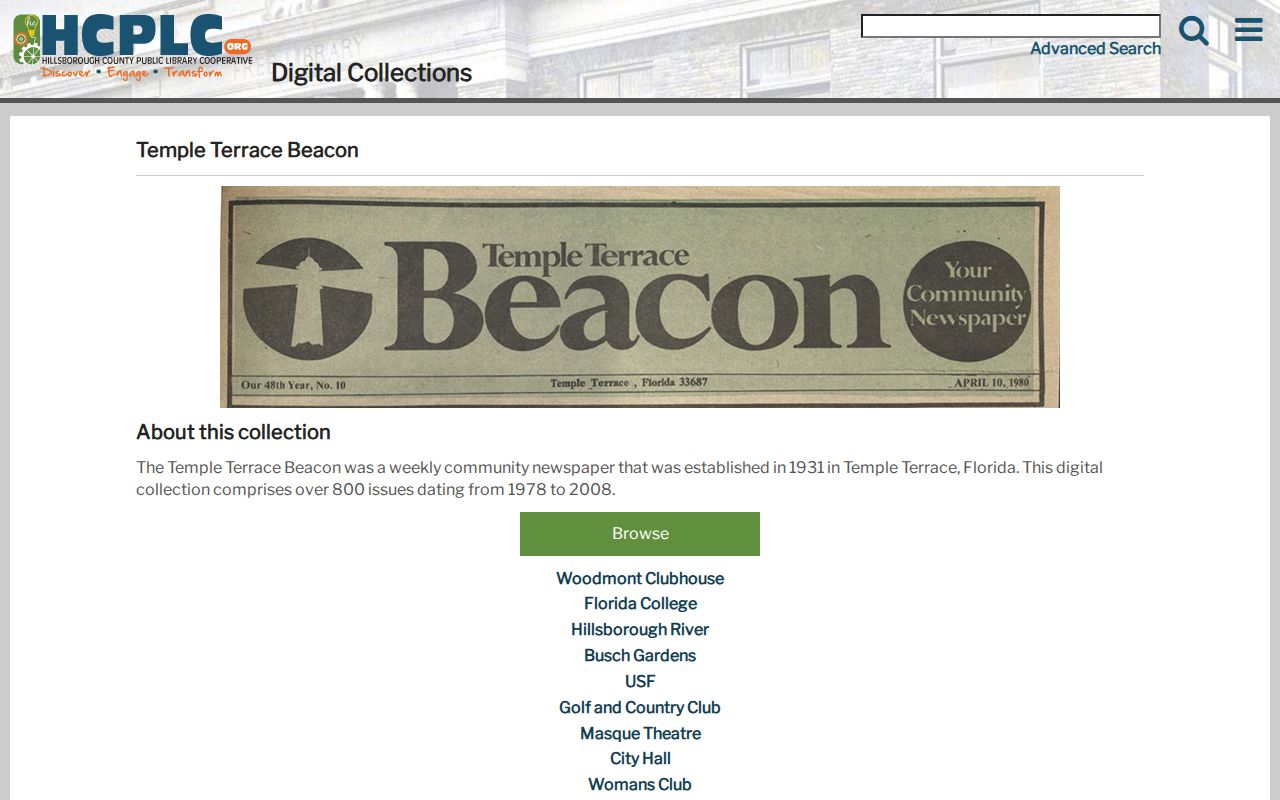
Follow each useful notice back to an official record when one exists. A social note may explain when someone arrived. A death notice can lead to the obituary index, probate docket, and next recorded deed.
Date Changes to Temple Terrace Homes
The city Permit History Request covers records issued since 1998. It searches by property address and returns the permit number, issue date, work description, and status or comments for selected building and trade categories. That can date a roof, addition, mechanical system, or other major change. It does not identify every person who lived there, and the applicant is not always the owner.
For earlier physical change, USF Special Collections has selected Hillsborough aerial sequences for 1938, 1957, 1960, 1966, 1972, 1976, 1988, and limited 1991 coverage. Compare the parcel against the aerial key map and original plat. Sanborn resources can add building footprint and use where a relevant sheet exists, but no Temple Terrace-titled atlas was verified. Do not claim coverage without checking the sheet.
The 1921 Temple Terrace Plan
The planned community grew from Temple Terraces, Inc. and a 5,000-acre Temple orange grove. Its circa 1921 master plan preserves the early lot and road pattern. That local quirk matters when a modern address string fails or when a deed uses a subdivision, block, and lot instead of a street number.
The city's history map provides the original visual reference. Bertha Palmer's earlier regional land interests and the development company can appear in pre-city chains. Temple Terrace did not incorporate until May 28, 1925, and a historical 1926 golf-course deed remains locally significant. City Council remarks are a lead, not a substitute for inspecting the recorded instrument.
No verified citywide renumbering event was found. Annexation usually keeps the street address while changing services and custodians. Use the plat and legal description to connect records rather than inventing a renumbering date.
Close a Temple Terrace Resident Trail
A person who disappears from directories may have moved, died, changed names, or simply been omitted. The Tampa Bay Obituary Index covers 1855 through 1990 and can lead to a notice naming relatives and places. Probate records can identify an estate representative, heirs, dates, and property-related filings. HOVER is the Hillsborough trial-court portal, though access varies and some family, probate, and juvenile material is role-gated.
Marriage licenses held by the Clerk reach 1831. State marriage and divorce abstracts begin June 6, 1927, while full divorce judgments remain with the court. Death-certificate access depends on age and content. For the first 50 years, cause of death and full Social Security number are restricted; a certificate without cause is available to adults under the researched Florida rules.
The aim is not to collect every private detail. Use probate, obituary, and vital records only to resolve a documented family-history or estate question, and respect redaction and eligibility limits.
Temple Terrace Previous Resident Limits
Previous residents must be described by source role. A grantee owned an interest. An assessed taxpayer appeared on a roll. A directory-listed occupant appeared in one publisher's dated volume. A census household was enumerated on one date. None of those labels can be silently converted into “lived here continuously.”
Records also have real gaps. The 1982 Temple Terrace Library arson destroyed 11,666 books and 1,010 recordings, but no source identifies which genealogy or directory runs were lost. It would be wrong to blame any specific missing volume on that fire. Likewise, Hillsborough's first courthouse burned in 1836, but Clerk holdings begin in 1836 and survival varies by series. Do not call it a total records loss.
Keep house history personal and lawful. Never use a past-resident trail to harass a living person or expose a protected address.