
Temple Terrace Directory Collections
Temple Terrace city directory research starts with a regional shelf. The Florida History & Genealogy Library, on the fourth floor of Tampa's John F. Germany Public Library, holds substantial Hillsborough and Pinellas telephone and city directories. The local Temple Terrace Public Library can help identify catalog records and database access, but its public page does not list a year-by-year directory run. Call before assuming that a certain volume is on its shelf. The City of Tampa Archives is another in-person source for Tampa directories and civic material.
| Collection | Years | Where Held | Access |
|---|---|---|---|
| Polk Tampa volumes | 1905 onward; scans for 1917-19, 1921-22 | FHGL, City Archives, Internet Archive | In person or free scans |
| Tampa/Hillsborough serial | HCPLC serial begins 1975 | Florida History & Genealogy Library | Print reference; confirm gaps |
| Temple Terrace Beacon | 1978-2008 | HCPLC Digital Collections | Free browse and search |
| Sentinel and Town Crier | 1940-46; samples 1948-49 | USF Digital Commons | Free scanned issues |
| Tampa Bay Obituary Index | 1855-1990 | HCPLC/FHGL | Index plus copy request |
No official complete online inventory identifies every Temple Terrace year or every reverse section. Early scans also predate the city's 1925 incorporation and should be treated as regional context, not proof that a household lived inside later city limits. Ask staff to check the title, year, geographic coverage, and street index before traveling. A missing name can mean an omitted household, a spelling variant, an unlisted phone, a move, or simply a gap in the surviving run.
Where Temple Terrace Directories Live
Temple Terrace Public Library at 202 Bullard Parkway is the nearest research door. Its staff can route researchers into the Hillsborough County Public Library Cooperative, newspaper databases, Florida Memory, USF Special Collections, and the regional obituary index. The Florida History & Genealogy Library at 900 N. Ashley Drive in Tampa offers a deeper shelf: more than 7,000 Florida-history reference titles, directories, Sanborn maps, newspaper microfilm, clippings, ephemera, and Burgert Brothers photographs.
Some tools require a library visit. Ancestry Library Edition is limited to library use, and HCPLC's FamilySearch affiliate status can reveal restricted images at a library terminal with a free account. The Temple Terrace branch is open Monday through Thursday 10 a.m. to 8 p.m., Friday 10 a.m. to 6 p.m., and Saturday 9 a.m. to 5 p.m. The Tampa genealogy floor runs Monday through Thursday 10 a.m. to 9 p.m. and Friday and Saturday 10 a.m. to 6 p.m.
See the HCPLC genealogy collection before a visit. Its online overview shows the breadth of sources that can extend a city directory result.
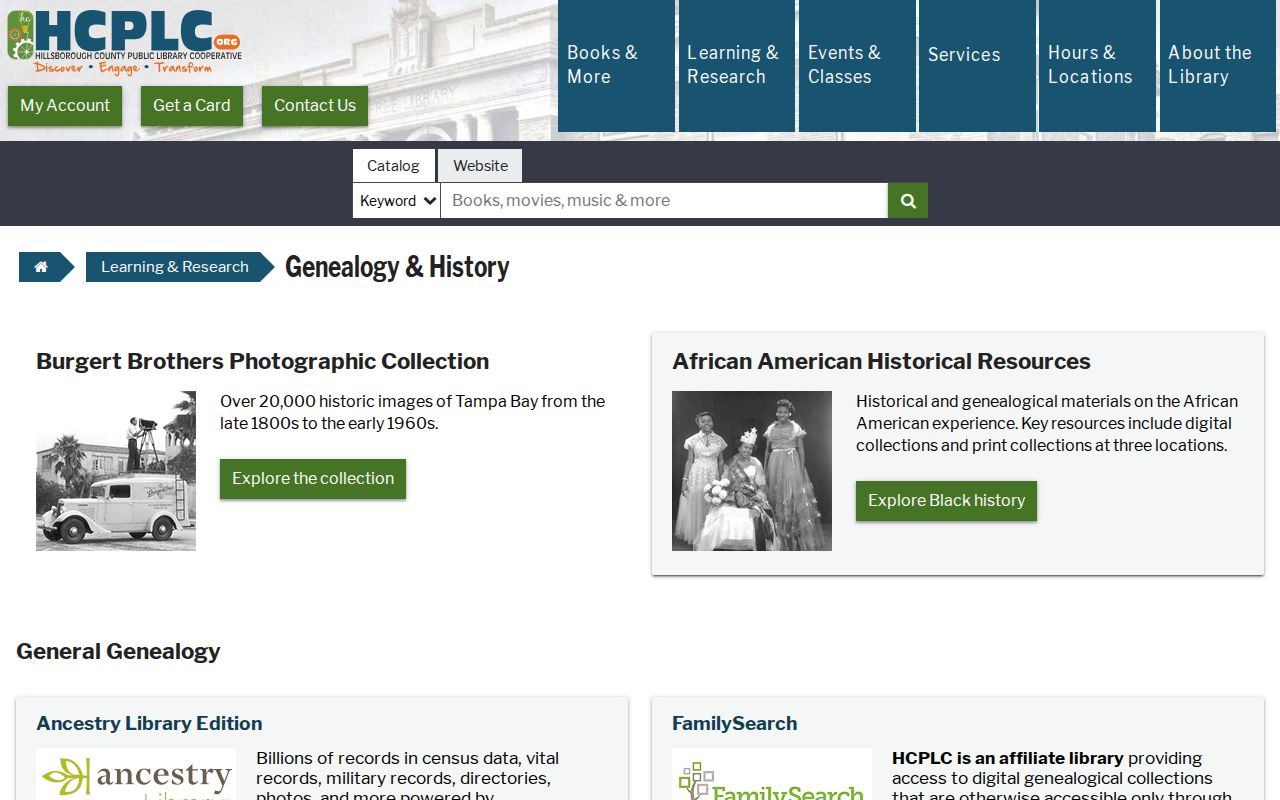
The collection page is a starting catalog, not a promise that every Temple Terrace volume has been digitized.
Reading Temple Terrace Directory Entries
A 1921 Polk Tampa volume shows the mechanics of an early city directory entry. It places the surname first, may add a spouse in parentheses, shortens the occupation, marks the place of residence, and ends with a street number and name. That sample is not a post-incorporation Temple Terrace household. It is evidence for how the publisher formatted regional entries. Always photograph or save the abbreviation key from the same volume before interpreting a letter.
| Name | Surname, given and middle name, sometimes a suffix such as junior |
|---|---|
| Spouse | A given name may appear in parentheses |
| Work | An abbreviated occupation and sometimes an employer |
| Residence | Number, street, and a municipal abbreviation |
| Marks | h can mean householder/home and r resides or rooms; confirm the key |
- Criss-cross directory
- A section arranged by street and house number rather than surname.
- Householder index
- A list keyed to the person identified as the main listed resident, not a complete household roster.
- Abbreviation key
- The publisher's legend for work, residence, street, and place codes used in that edition.
Do not translate h and r automatically into legal ownership or a lease. Compare the entry with the Hillsborough property roll and a deed. A directory records what its compiler printed, while the deed and parcel card answer different questions.
Temple Terrace Names in Print
Newspapers bridge gaps between directory editions. The Temple Terrace Beacon archive contains more than 800 weekly issues from 1978 through 2008. It includes city government, schools, clubs, businesses, photographs, advertisements, announcements, and obituaries. These details can explain why a name appeared, moved, changed form, or vanished from a directory.
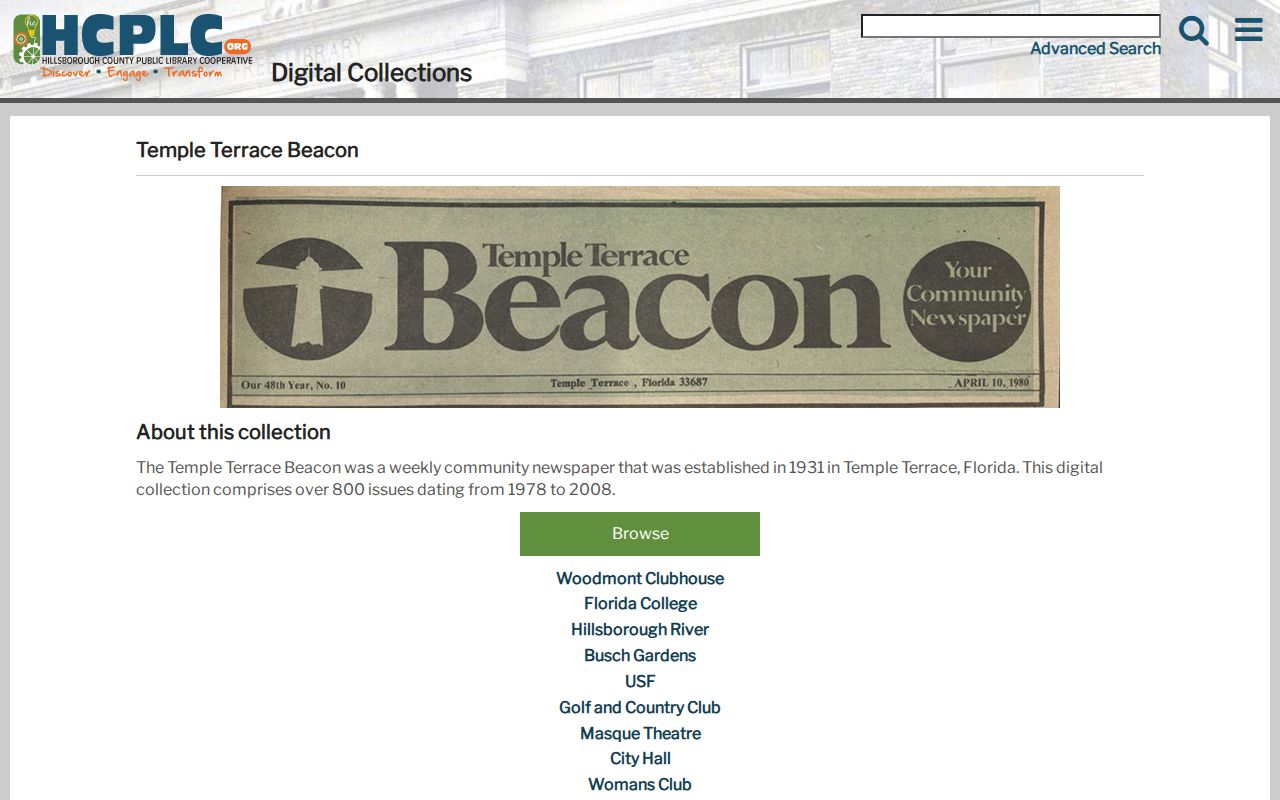
The scanned weekly record adds context, but an announcement is still not proof of legal residence or ownership.
The Temple Terrace Sentinel collection covers 1940 through 1946, with Town Crier samples from 1948 and 1949. Its reports of births, deaths, illness, civic notices, and classifieds help connect a household to the city between census years.
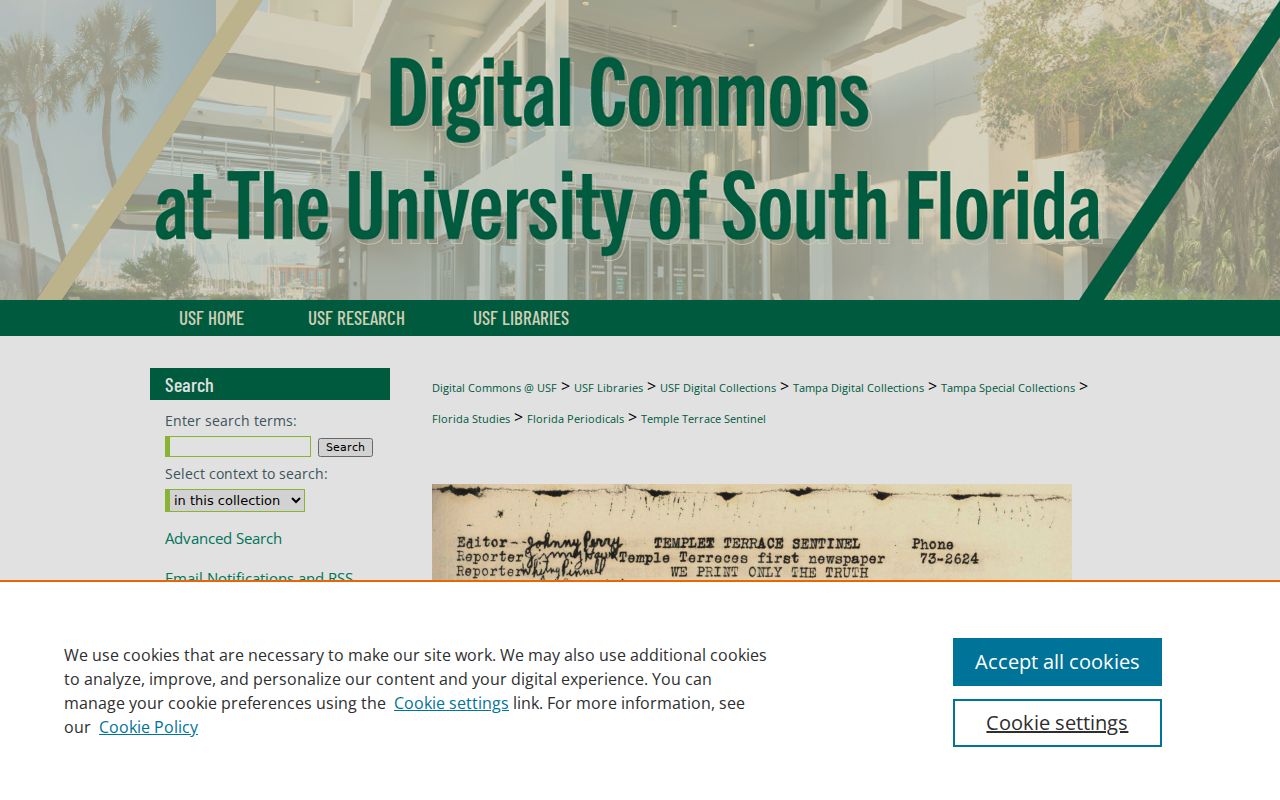
Together, the two newspaper runs give Temple Terrace a stronger local layer than a metro directory alone.
Trace Temple Terrace Family History
A city directory is most useful as one frame in a longer sequence. Begin with a known name and street, then move both forward and backward. Preserve initials, suffixes, spouse names, work terms, and every address form. Pair the annual or periodic listing with a deed, newspaper item, obituary, and released federal census. The 1950 census is the latest open census under the 72-year rule; the 1960 census opens in 2032.
- Find the first likely alphabetic entry and copy it exactly.
- Check nearby years, recording address, spouse, work, and spelling changes.
- Use a reverse section, if that volume has one, to inspect the street sequence.
- Pair 1940 and 1950 listings with the released census household schedules.
- Follow a disappearance through the obituary index, probate, deeds, and local newspapers.
Absence is not proof that someone left Temple Terrace. A volume may omit the person, use a spouse's listing, miss the street, or exclude an unlisted telephone subscriber. The Temple Terrace resident lookup can test a modern name across other official indexes without rebuilding the historical shelf.
Temple Terrace Before Incorporation
Temple Terrace incorporated on May 28, 1925. Earlier directory, land, and business evidence may sit under Tampa-area or Hillsborough headings instead of the later city name. Developers formed Temple Terraces, Inc. in 1920 around a planned golf community and a 5,000-acre Temple-orange grove. The city's 1921 master-plan map helps connect early lots and curved roads to later addresses.
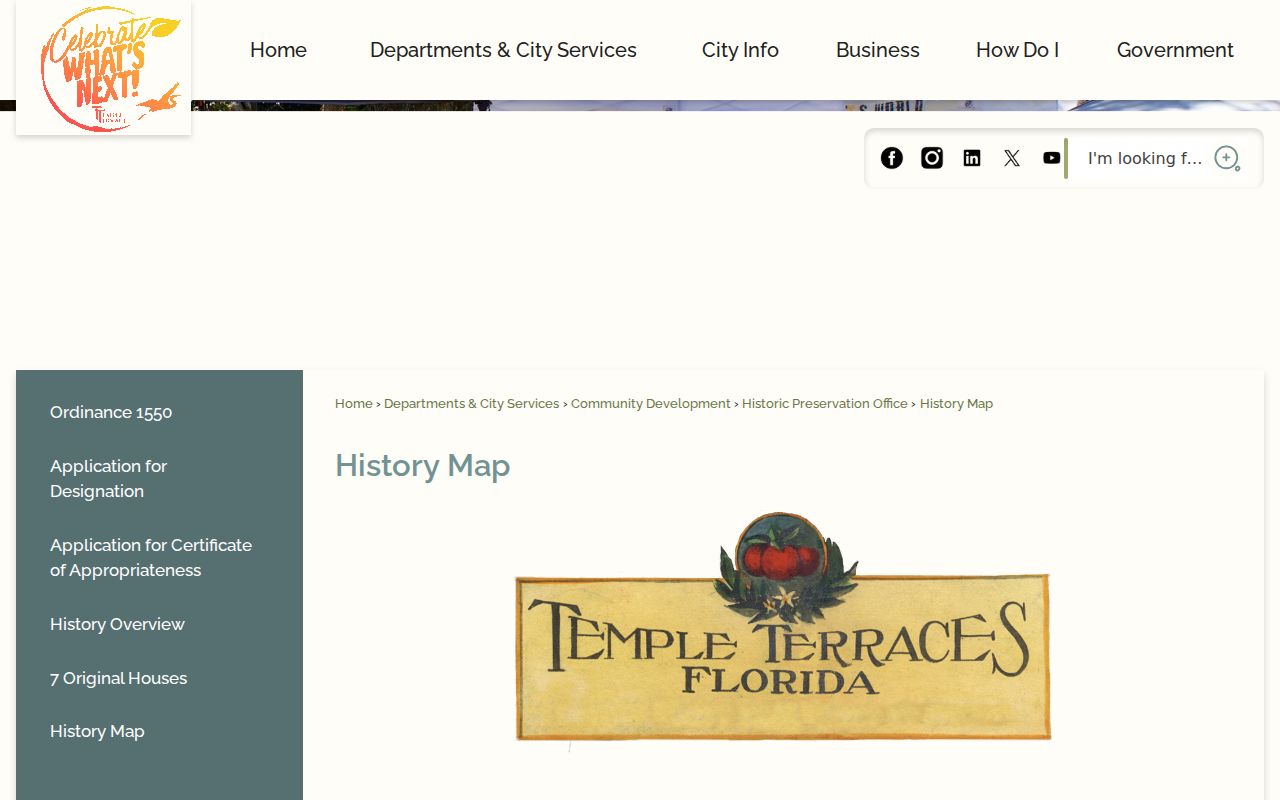
The map can explain street form and lot context, but it does not name every resident. Use it with plats, deeds, tax rolls, and directory entries.
Photographs Beyond City Directories
USF Special Collections and HCPLC's Burgert Brothers holdings add people, streets, residences, churches, and businesses to a written directory find. The photographic range reaches from the late nineteenth century into the 1960s, with much of the work concentrated in the 1920s and 1930s. USF also holds Hillsborough aerial key maps for 1938, 1957, 1960, 1966, 1972, 1976, 1988, and limited 1991 coverage.
Aerials show the parcel and neighborhood changing. They do not identify occupants. Search by street, subdivision, institution, and family name, then compare captions, dates, and catalog provenance with the directory year.
The Temple Terrace Library Fire
The local library began through Woman's Club work in 1959, opened in a donated golf caddy and pro-shop building in 1960, moved to City Hall in 1961, and reached its present site in 1966. An arson fire on February 18, 1982 destroyed 11,666 books and 1,010 recordings. Temporary service returned within six weeks, and the rebuilt library opened on February 16, 1983.
No source identifies the directory titles or years lost. That limit matters. Do not convert the known book count into a claim that a specific Temple Terrace city directory run disappeared. Search the regional genealogy library, City Archives, USF, and institutional scans for duplicate copies.
Note: A catalog gap is not proof that a directory never existed; ask staff to check uncataloged runs, microfilm, and regional holdings.
Temple Terrace Newspapers Bridge Directory Years
Two digitized community newspapers help fill years when a city directory is missing or too terse. USF's Temple Terrace Sentinel collection covers 1940 through 1946 and includes community reporting and Town Crier material. The Hillsborough County Public Library Cooperative's Temple Terrace Beacon collection spans 1978 through 2008. Search a surname, street, club, school, church, or business, then record the issue date and page because newspaper text is evidence from a particular moment rather than proof of continuous residence.
Newspaper notices can expand an abbreviated directory line into a household story. Weddings and obituaries connect relatives; civic columns connect a name with an organization; advertisements connect proprietors with a business address; and property reports may explain a move. OCR is imperfect, especially on older scans. Search initials, spouse names, street fragments, and likely misspellings, and inspect the page image before quoting a result.
The Tampa Bay Obituary Index adds another bridge for deaths reported between 1855 and 1990. An index entry points toward a newspaper; it is not the obituary itself and does not replace a death certificate. Pair the article with the directory entry, deed, probate file, or released census schedule so each relationship rests on more than one source.
Where Temple Terrace Directory Research Continues
Online collections are only one access channel. Temple Terrace Public Library at 202 Bullard Parkway participates in the countywide cooperative and can route researchers to genealogy databases, local publications, Sanborn maps, Florida Memory, USF Special Collections, and other regional holdings. The Florida History and Genealogy Library in Tampa holds substantial telephone and city-directory material, though an exact Temple Terrace criss-cross year run was not verified in the online catalog. Ask staff to confirm a year, publisher, volume title, and whether an address section exists before traveling.
The City of Tampa Archives and Records Service, Tampa Bay History Center, USF, and the State Archives catalog provide additional paths when a local shelf stops. A useful request gives the person's full name, variants, approximate years, known street or employer, and the exact sources already checked. Ask whether quoted coverage describes a catalog index, digitized image set, microfilm, or original volume; those ranges can differ.
For address continuity, combine the 1921 master-plan map with plats and HCPA parcel geometry. For household continuity, compare directories with released federal census schedules and dated newspapers. For legal ownership, move to the Hillsborough Clerk's deed chain. Keeping those roles separate prevents a map label, directory abbreviation, or newspaper mention from being overstated as current residence.